| Michelle Sciabarassi, PTA is one of our staff Physical Therapist Assistants and is the lead Rock Climbing Wall Trainer. |
| | |
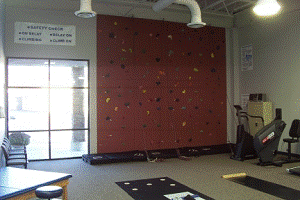
| | The wall itself is 15 ft. in height and is 16 ft across. |
| | |
| | We have 3 climbing/repelling stations |
| | |
| | For those of you who have done indoor rock climbing before, we will have 4 routes.
|
| | |
| | For those of you who have not done indoor rock climbing before, it is very safe. |
| | |
| | All of our Climbing equipment goes through a safety inspection daily. |
| | |
| | All staff involved with the Rock Wall are completely trained in safety with indoor rock climbing and need to pass specific training tests prior to their use of the wall |
| | |
| | Climbing requires 2 people: The belayer (The person who is controlling the amount of rope/tension that the climber needs to climb up the wall) is at the bottom and the climber climbs up the Rock Wall. All Climbers are strapped into a safety harness and are assisted by one of our staff on the floor who helps control tension of the rope and assists the climber with any issues the climber may have. |
| | |
| | Many of our clients will participate in “Bouldering”. This is where one traverses the wall side to side instead of up and down. They climb no higher then shoulder height and have a 6” crash pad underneath them. This is just as safe as rock climbing, yet requires more work. |
| | |
| | Rock climbing is a great way to cross train for other sports (i.e. cyclists, hikers, swimmers) |
| | |
| | Rock climbing will improve balance, strength, coordination, core strength, and endurance. |
| | |
| | It’s function for Physical Therapy will be to increase balance, dexterity and upper and lower body strength
 |


